



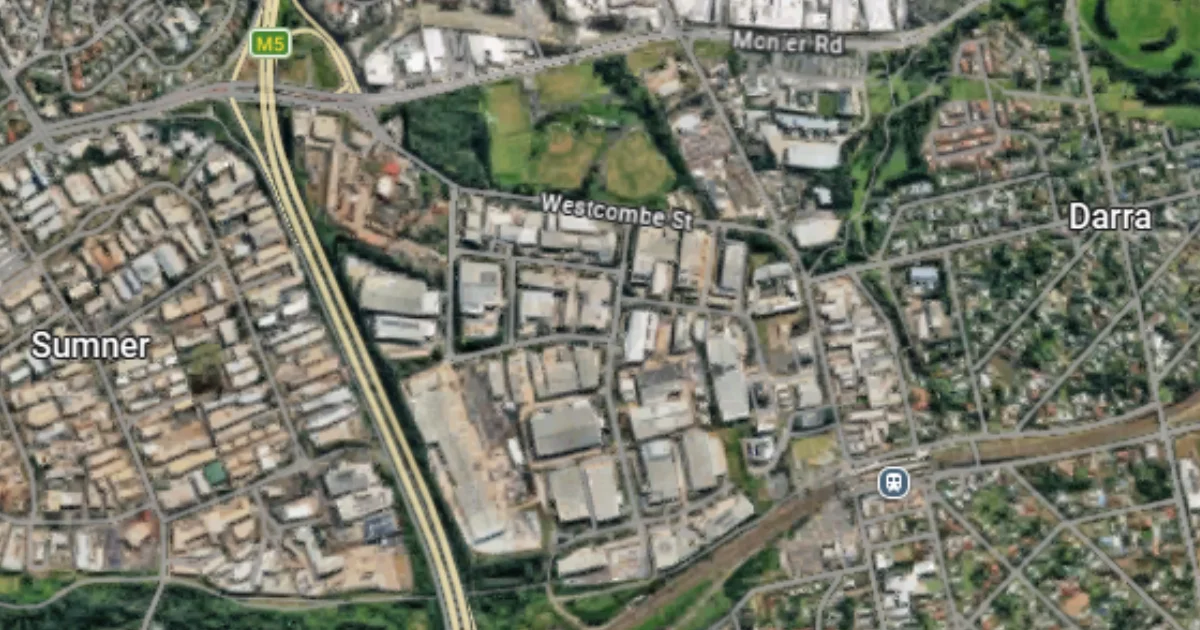
Men in Darra-Sumner are living more than a decade longer than men in Inala-Richlands — and for women, the divide is even greater — according to new University of Queensland research that has mapped health outcomes across Brisbane using the city’s suburban rail network.
Read: Life Begins at 60: Enjoying More of What Matters at Kingsford Terrace Corinda
The findings come from a study published in the Health Promotion Journal of Australia that overlaid median age of death statistics onto Queensland’s rail network to expose spatial inequalities in health. Rather than projecting future life expectancy, the research tracks median age of death, the actual age at which residents in a given area have passed away, an approach the research team noted gives planners and communities a practical reference point for understanding and acting on the findings.

For residents of the Centenary corridor and surrounds, the data points to a divide that sits uncomfortably close to home. Men in Darra-Sumner have a median age of death of 81 and women 86, while just down the road the figures tell a markedly different story. And how much of that difference comes down to structural and social factors rather than individual behaviour alone makes for sobering reading.
How the Study Worked
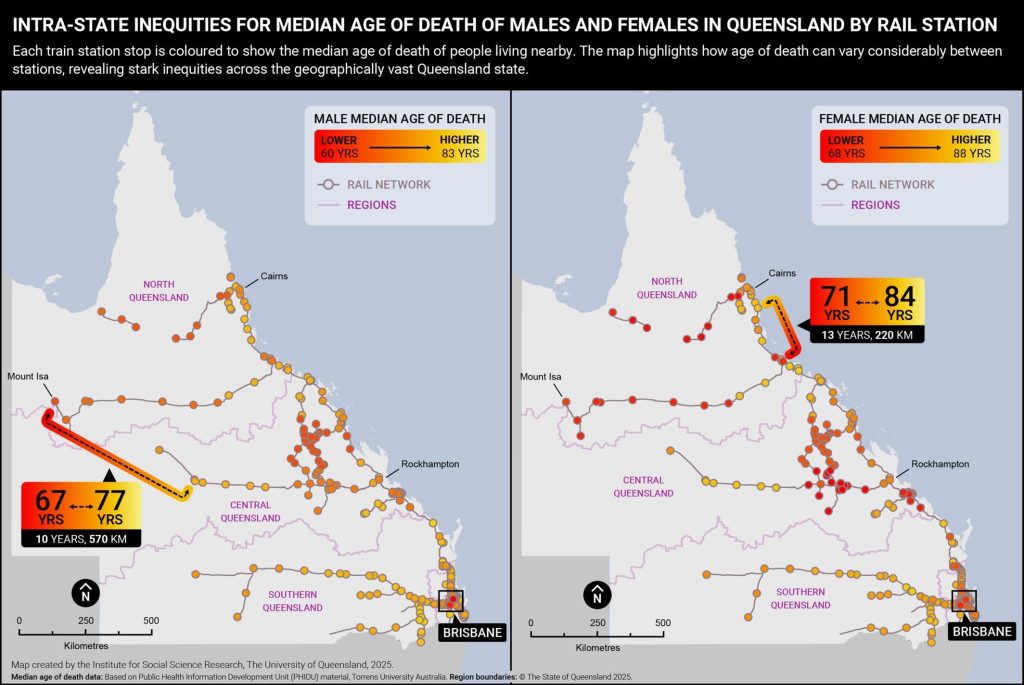
Associate Professor Jonathan Olsen from UQ’s Institute for Social Science Research led the study, using train stations as geographic markers to map health data across the state. The same method has previously been applied in Glasgow, London and New York.

Across Queensland, the median age of death for women ranges from 68 to 88, and for men from 60 to 83 — a statewide spread that sets the context for the sharper suburb-level contrasts the research identifies.

What the Data Shows for Darra-Sumner and Inala
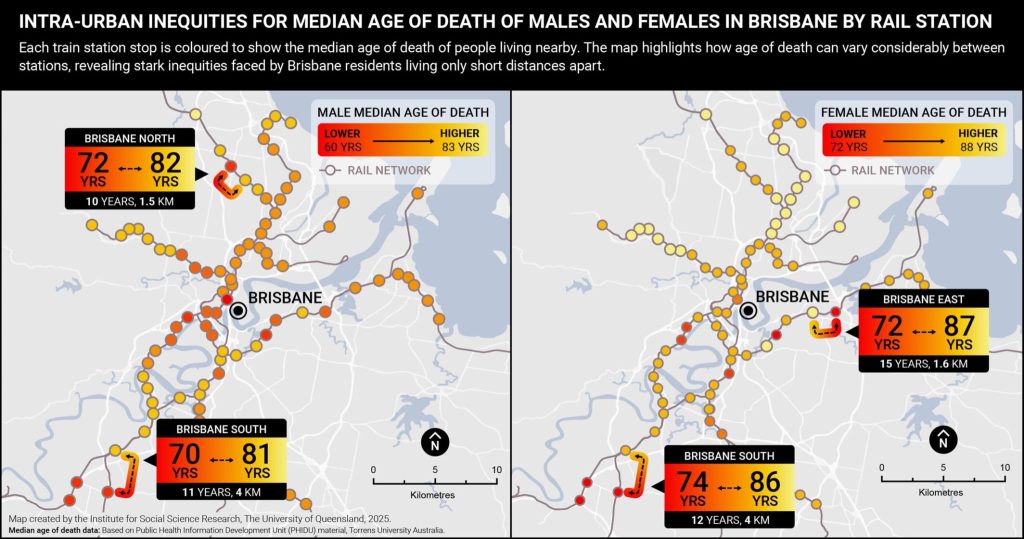
The contrast between Darra-Sumner and Inala-Richlands is one of the more striking findings in the Brisbane dataset. Men in Inala-Richlands have a median age of death of 70 — 11 years below the figure for men in Darra-Sumner. Among women, the gap reaches 12 years, with Inala-Richlands recording 74 against Darra-Sumner’s 86.
Both Darra and Inala are well known for their multicultural communities and sit within Brisbane’s south-western suburbs. But the census data points to structural differences that the research links to health outcomes.
Inala has a higher proportion of Aboriginal and Torres Strait Islander residents than Darra. Indigenous Australians face significant and well-documented health disparities compared to non-Indigenous Australians — a disparity rooted in historical dispossession and ongoing systemic disadvantage, not culture or lifestyle. Inala residents also record lower average household incomes, and the suburb has higher rates of single-parent households, a factor the researchers identify as contributing to health disadvantage.


The Same Pattern Across the City
The Darra-Sumner and Inala-Richlands comparison sits within a broader pattern the research identified across Brisbane.
On the Cleveland line, women near Murarrie station had a median age of death 15 years lower than women near Cannon Hill, despite the two stations sitting just 1.6 kilometres apart. Census figures showed Murarrie had higher rates of divorce, unpaid care and female single-parent households — factors the researchers link to worse health outcomes for women.
On the Redcliffe Peninsula line, men near Zillmere station had a median age of death 10 years below that of men near Geebung, just a few stops away.
Why the Gaps Exist

Olsen said population health is shaped by a broad range of social, environmental, economic, cultural and commercial factors. Income, housing security, access to education and employment, nearby green space, and the availability of local services all shape health outcomes over a lifetime, he said.
Spatially referenced data, he noted, can guide place-based health initiatives such as upgrading parks and green space and expanding infrastructure for active travel — and those interventions work best when co-designed with the communities they serve.
What the Research Is Designed to Do
Olsen was clear that identifying specific areas at the harder end of the data is not about stigmatising communities. He said the aim was not to single out any suburb as having the worst health outcomes in Brisbane, but rather to draw attention to the variation in health outcomes between places in a way that could be acted on.
The goal is to give policymakers and health officials a detailed, location-specific picture of where need is greatest — and to make the case for targeted investment in upgraded parks, bike paths, and community health support.
Read: Life on the River Shapes Riverhills Rowing Community
Olsen added that the research also helps people recognise that even within inner-city Brisbane, suburbs sitting close together can have residents whose health outcomes differ considerably.
Published 3-March-2026